Today, the entire class period was set aside so that we could learn more about some aspect of Native American history, culture, or current issues. I decided to investigate cultural appropriation, as I had read a little about the matter when it applied to African American culture on Twitter, and I wanted to learn more. Cultural appropriation is when one takes an aspect of another culture and acts as if it is his or her own. This is a largely negative trend and is offensive to the cultures it borrows from.
TIME Magazine outlined the topic excellently by examining the difference between cultural appropriation and simply showing appreciation for a culture.
It discussed how, first of all, the importance of clothing to this complicated area of controversy, since clothing is so intrinsic to a sense of cultural identity. I learned that "[...] putting on another culture’s clothes is a greater claim to ownership and belonging than sampling sushi or buying a burrito for lunch." In this analogy, cultural appropriation is like identity theft.
I began to understand more about the difference between what is offensive and what is flattery when I read from the article that to be aware of their distinction, attention has to be paid to: the significance of the garment being worn to the culture it references, the similarity of the garment to the garment actually used by the culture, whether the culture desires for its style to be emulated, and whether or not there has been a trend of oppression or discrimination against the culture.
So, it makes more sense that Pharrell Williams received an abundance of backlash from the public when he wore a Native American headdress on the cover of a magazine. He had no idea what the headdress meant to Native American culture. He just wore it because it looked cool. He did not simply take slight stylistic inspiration from Native American attire; he copied it exactly. Additionally, Native Americans definitely have a history of oppression. This was cultural appropriation of Native American culture.
Other recent culprits are Karlie Kloss of Victoria's Sercret and Heidi Klum of Germany's Next Top Model. Klum promoted a photo shoot titled "Redface" in which contestants of the show modeled as Native Americans. It was racist and offensive; it sexualized stereotypical Native American culture, and it was not even accurate.
This is an extremely derogatory tendency of modern society, and since I looked into it more today, I am outraged.
Wednesday, September 30, 2015


Thursday, September 17, 2015
Film Essay
Liddy Malone
Film Essay
In the exhilarating glory days of elementary and middle school, there was no greater joy to my classmates and I than when a teacher rolled in an ancient, enormous television on a tall, black cart. “We’re watching a movie!” we whispered excitedly to each other. It was a treat, and we were excused from the usual schedule of worksheet after worksheet. However, even then, it was not a day off. Even fictitious movies about the historical time periods we were studying gave us a better understanding of the topic. This phenomenon applies to us even more as post-pubescent high school students; as we grow more mature, we can glean even more understanding from films. Using a critical attitude and a bit of outside research, a viewer can watch a movie and learn plenty about events and time periods of the past. For example, because of the films Glory and 12 Years a Slave, our history class became more familiar with the African American struggle during slavery and the Civil War. This is thanks to the visual element of learning that movies bring to the table.
Glory, directed by Edward Zwick, was made in 1989. It was a popular film, grossing $26,830,000 in the United states with a budget of about $18,000,000, according to IMDb. It also received a plethora of awards. The New York Times article by Vincent Canby lists several, including Denzel Washington’s award from Hollywood Foreign Press for Best Performance by an actor in a supporting role in a Motion Picture. James Berardinelli expresses in his ReelViews review of the movie that, because of its acknowledgement of African Americans involved as soldiers during the Civil War, Glory is incredibly unique. This is one reason for its popularity. It tells the true story of the 54th Regiment of Massachusetts, which was the first black regiment in the Civil War. An argument barely has to be made that watching a well-made motion picture about a true story, especially one that sheds light on a time of history that is rarely punctuated, is beneficial to the education of viewers.
As Vincent Canby notes, Glory is based on two different books- “Lay This Laurel” by Lauren Kirstein and “One Gallant Rush” by Peter Buchard. It is also based on the personal letters of Colonel Robert Shaw, who leads the regiment in the movie. Canby applauds how the characters excellently serve their purpose of setting the scene, accurately portraying the history behind it. He also praises the great depiction of the 54th attacking Fort Wagner, saying it “...comes as close to anything [he’s] ever seen on screen to capturing the chaos and brutality…” Many students, such as myself, are visual learners. Watching this movie “capture” the nature of Civil War battles helps me picture and understand the true feeling of the war at least as much, if not more, than my history book can.
12 Years a Slave helps me visualize the life of a slave in much of the same way. Even more popular than Glory, this film, as I learned from Box Office Mojo, grossed $187,733,202 worldwide. Britannica Academic notes how gripping it is to both its audience and critics because, like Glory, it sheds a unique light on the time period. It explores the cruelty of slavery. It follows one character, Solomon Northup (whose narrative in 1853 actually gives this film its story), but gives deep insight into the struggles of slaves and their horrific conditions in general. I can vouch for this description; this film allowed me to feel like I was there with Solomon. Its vivid images made my understanding of the horrors of that time much clearer.
Catherine Shoard’s article from The Guardian expounds upon the motivations of director, Steve McQueen. He wanted to create strong visual imagery of slavery. He stated, “When you see the ins and outs of it, it does something different. And if that starts a conversation- wonderful, excellent.” Here, he is speaking about the emotional, rather than intellectual, thought inspired by seeing the harsh slave conditions, rather than reading about them. As my jaw dropped several times while viewing the movie, I agree that he succeeded in making an excellent visual representation.
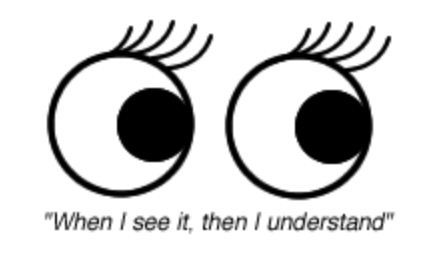
Without watching these movies, my knowledge of slavery and the Civil War would be much more narrow. While studying the cold hard facts is undoubtedly important, a visual element, like a movie, that goes along with any subject matter is an excellent supplement. It truly allows a more complete understanding, because it forces the viewer to see it for him or herself. Though a history book can have paintings, those are just snapshots. In contrast, a motion picture can truly provide “the whole picture.”My image: visual leaning.
Sources
Glory (1989) from the New York Times by Vincent Canby, December 14, 1989
Glory director Edward Zwick discusses motivations behind the film, by Michelle P. Perry, The Tech, MIT newspaper, 1990
12 Years a Slave awards article from Encyclopaedia Britannica Academic, 2015
‘12 Years a Slave’: An essential story, well told at last, by critic Steven Rea, The Inquirer, Philly.com, October 25, 2013
Steve McQueen on 12 Years a Slave: ‘It’s not About sugarcoating history,’ The Guardian, by Catherine Shoard, September 7, 2013
How 12 Years a Slave Gets History Right: By Getting It Wrong, The Atlantic, October 28, 2013, Noah Berlatsky
Friday, September 4, 2015
Practice Incorporating a Quotation
In the Civil War movie Glory, the narrator, Colonel Shaw, is isolated from his men in the Massachusetts 54th by an incredible social barrier. However, as the story progresses, all the men become closer and more united in the war effort. By the end, in their final battle, a sense of brotherhood is evident between the infantry. While addressing this phenomenon, the author of a review from Reelviews, James Berardinelli, wrote: "In the heat of the fight, men are color blind."
I refreshed my memory on the importance of both paraphrasing and incorporating quotes and their appropriate uses during class today. First of all, I was reminded that going line by line through a passage I want to paraphrase makes it difficult to avoid copying entire phrases, which is to be avoided in paraphrases. I became better at hyperlinking. Also, I learned that it is just as important to accurately convey what the author is saying. Additionally, I was reminded of how useful quotes can be in my writing. Sometimes in the past, I avoided using them because of an incorrect mindset that they are an "easy way out" of sorts. However, a pithy quote can often be beneficial and supplementary to an essay or paper. I will definitely use them more in the future.
This is what Mrs. Lawson wanted me to learn today:
I refreshed my memory on the importance of both paraphrasing and incorporating quotes and their appropriate uses during class today. First of all, I was reminded that going line by line through a passage I want to paraphrase makes it difficult to avoid copying entire phrases, which is to be avoided in paraphrases. I became better at hyperlinking. Also, I learned that it is just as important to accurately convey what the author is saying. Additionally, I was reminded of how useful quotes can be in my writing. Sometimes in the past, I avoided using them because of an incorrect mindset that they are an "easy way out" of sorts. However, a pithy quote can often be beneficial and supplementary to an essay or paper. I will definitely use them more in the future.
This is what Mrs. Lawson wanted me to learn today:
- Only use a quote when it adds power and style to my writing.
- Always make it clear, from context, that I understand the full meaning of the quote.
- Whenever I quote or paraphrase, always be transparent about the source and how I'm using it.
- If I use an author's exact words or phrases, to any extent, I have to use quotation marks and give credit.
- If I use another author's presentation of facts or ideas, but put their ideas in my own words, I better have a good reason for doing that, and I MUST give credit.
- Hyperlinking is so easy, there is no excuse for not being transparent about my sources.
I truly believe that I understand these concepts entirely. Let's go.
Paraphrase Practice
The following excerpt comes from a review of a Civil War movie, Glory, from Reelviews Movie Reviews.
"The historical backdrop against which Glory transpires is mostly historically accurate. In fact, a great deal of effort went into getting the details correct. The main events shown in the film happened much as they are depicted, some of the key characters (Shaw, Frederick Douglas, etc.) existed, and the outcome was as Zwick presents it. Many of the secondary characters are either partially or entirely fictionalized, but they are intended to represent a broad cross-section of the types of men who joined the Massachusetts 54th. The danger in this approach is that it becomes easy to trivialize the individuals, turning them into types rather than people. Fortunately, Jarre's screenplay avoids the trap. The characters in Glory never seem less than three-dimensional."
Though not all of the characters in the film Glory are based on real people, a handful, like the narrator, Colonel Shaw, actually existed during the Civil War. Many other aspects of the movie are historically authentic, as well. A large amount of the director's effort was spent perfecting small details. While plenty of the characters playing smaller roles were created solely for the movie, their personalities and backgrounds give an accurate representation of the nature of soldiers in the 54th Regiment of Massachusetts Volunteer Infantry. The screenplay goes above and beyond mediocracy by excellently developing these fictional characters instead of making their personalities paper-thin or overly stereotypical.
Wednesday, September 2, 2015
Blog Post 1 - Empathy & History
Empathy and sympathy are two somewhat related concepts that can be easy to muddle together. However, there is a key difference between them that is important to understand, especially in a history classroom. While having sympathy is relating emotionally with another person who is struggling or suffering, having empathy is understanding another person's perspective in a certain situation on a strictly intellectual or logical level. It is sometimes necessary to put empathy before sympathy in many professions, especially a historian's. Though sympathy is a highly valued trait of an emotionally sound person, having empathy can lead to having pure, unbiased understanding, even when it is difficult.
For example, I can empathize with my mother, even when she is telling me to do something that frustrates me exponentially. I am a "neat-freak". I am a perfectionist, and I am nervous, choosy, and stubborn. All of the above apply. With all of these characteristics, it bothers me more than almost anything else when my messy, sometimes careless younger sister leaves her dirty towels on the floor and her open jars of peanut butter on the countertop. What is even more infuriating is that it is a household rule of my family that I cannot nag her about it. My mother is particularly stringent about how siblings should not give each other parental directives; that is entirely up to her and my dad. It is so frustrating when my sister does not clean up after herself, because I feel like they do not get on to her as much as they should. Nevertheless, like a historian, I can empathize. I have never had children, and I hate the rule, but using unbiased logic, I can understand why the rule is in place. My mother does not want one of her daughters to have any unnatural power over the other. She does not think it is my place when I nag, just like she does not think it is my sister's place to yell at me for other reasons. I do not support the rule in any way, as a bossy, stubborn teen, but I can understand it intellectually. I get why it's a rule.
Anyone studying the past must master empathy. There are plenty of instances where it might make a person uncomfortable to "walk a mile in the shoes" of some of the infamous characters in history. Understandably, it is less burdensome on the conscious and more uplifting to put oneself in the position of a hero. However, if someone does not understand the perspectives of all of the people who shaped the present, at least in a purely intellectual way, they cannot truly understand history. They are leaving out the "why" and "how" from their knowledge of the time.
Here is a photo of the kind of mess my sister makes on the daily. She stinks. Here is a photo that visually represents empathy to me.
For example, I can empathize with my mother, even when she is telling me to do something that frustrates me exponentially. I am a "neat-freak". I am a perfectionist, and I am nervous, choosy, and stubborn. All of the above apply. With all of these characteristics, it bothers me more than almost anything else when my messy, sometimes careless younger sister leaves her dirty towels on the floor and her open jars of peanut butter on the countertop. What is even more infuriating is that it is a household rule of my family that I cannot nag her about it. My mother is particularly stringent about how siblings should not give each other parental directives; that is entirely up to her and my dad. It is so frustrating when my sister does not clean up after herself, because I feel like they do not get on to her as much as they should. Nevertheless, like a historian, I can empathize. I have never had children, and I hate the rule, but using unbiased logic, I can understand why the rule is in place. My mother does not want one of her daughters to have any unnatural power over the other. She does not think it is my place when I nag, just like she does not think it is my sister's place to yell at me for other reasons. I do not support the rule in any way, as a bossy, stubborn teen, but I can understand it intellectually. I get why it's a rule.
Anyone studying the past must master empathy. There are plenty of instances where it might make a person uncomfortable to "walk a mile in the shoes" of some of the infamous characters in history. Understandably, it is less burdensome on the conscious and more uplifting to put oneself in the position of a hero. However, if someone does not understand the perspectives of all of the people who shaped the present, at least in a purely intellectual way, they cannot truly understand history. They are leaving out the "why" and "how" from their knowledge of the time.
Here is a photo of the kind of mess my sister makes on the daily. She stinks. Here is a photo that visually represents empathy to me.
Subscribe to:
Posts (Atom)