This has been an incredible year for thinking. I was able to learn not only the facts, but the hows, whys, and "what can I do"s about my country. I feel much more curious about the social and political elements of the United States and more empowered to explore such issues. I really cannot wait to take AP Euro next year; I'm extremely glad I made that decision.
Thirteen Days circled the Cuban Missile Crisis and gave the viewer an inside scoop, of sorts, to the process behind all of the United States' decisions. The point of the movie, made evident through dialogue and Mrs. Lawson's side notes, was that we, as citizens of the United States, are responsible to be responsible. Like the president, the military, Congress, and the cabinet were responsible for making decisions, even though they might have felt unqualified to do so, we have no safety net, but we are obligated to be socially conscious.
Monday, May 23, 2016

Friday, May 6, 2016
Letter to the Future
Dear Future Citizen of 2216,
Our names are Avani Reddy and Liddy Malone. We just spent time investigating climate science, and we’d like to share with you what students from 2016 know about the topic.
We’ll start with the basics. First of all, climate is the typical weather pattern of a place over a long period of time, according to the United States Environmental Protection Agency (1). It can include average patterns in precipitation, temperature, and weather events. People in this century can often confuse it with weather, but weather refers to a given time.
The British Geological Survey states that today’s geologists can find evidence of the characteristics of a past climate by looking at the landscape, rocks, fossils, and even pollen and spores (2). Where they find till, they know glaciers were once there, and they know that location had a cold climate. Till is formed from dirt and residue dropped by melting glaciers. Also, iron deposits make some rocks red and can indicate a past desert environment. Fossils give evidence of past species that scientists know needed certain conditions from the environment to exist. Pollen and spores have outer cases that let them be easily fossilized. Scientists can use this evidence the same way they do with animal fossils. Finally, looking at the shape of the land and boulders called erratics that are known to be left by glaciers, scientists can see how glaciers shaped the Earth.
Research shows us that the Earth’s climate has had a pattern of change throughout time. While today, there are some skeptics who take this as evidence that recent trends in the environment are all part of the pattern, there is scientific evidence that proves that human-induced climate change is occurring.
As a result of climate change, the Earth becomes warmer; there is more precipitation, more evaporation, warmer oceans, less glaciers, and increased sea levels (3). One of the benefits of climate change include that plants will grow faster. Crops such as, wheat and rice, tend to grow better in higher temperatures (4).
While there is a lot of scientific evidence to prove that climate change is happening, there are still some who question. These skeptics believe that atmospheric temperatures have not risen significantly since 1998. The Nature.com website says, “That [atmospheric temperatures not rising] has led skeptics - and some scientists - to the controversial conclusion that the models might be overestimating the effect of greenhouse gases, and that future warming might not be as strong as is feared” (5). These people also believe that the increase in the number of stratospheric aerosol particles could be keeping the earth cooler than predicted.
However, from our research over the past few weeks, we know that human-induced, significant climate change is happening.
First, we can look at carbon dioxide trends. The NOAA website has data that shows the carbon dioxide levels in the atmosphere have not exceeded approximately 170 to 300 parts per million over the last 800,000 years (6). Natural causes made the carbon dioxide concentration vary in this range. However, since the Industrial Revolution, it has increased by about 35%. If humans continue their established trend of emitting large amounts of carbon dioxide through burning fossil fuels and keeping up their agricultural practices, it is projected that carbon dioxide concentrations will double or triple the highest levels in the past 800,00 years.
While there is a lot of scientific evidence to prove that climate change is happening, there are still some who question. These skeptics believe that atmospheric temperatures have not risen significantly since 1998. The Nature.com website says, “That [atmospheric temperatures not rising] has led skeptics - and some scientists - to the controversial conclusion that the models might be overestimating the effect of greenhouse gases, and that future warming might not be as strong as is feared” (5). These people also believe that the increase in the number of stratospheric aerosol particles could be keeping the earth cooler than predicted.
However, from our research over the past few weeks, we know that human-induced, significant climate change is happening.
First, we can look at carbon dioxide trends. The NOAA website has data that shows the carbon dioxide levels in the atmosphere have not exceeded approximately 170 to 300 parts per million over the last 800,000 years (6). Natural causes made the carbon dioxide concentration vary in this range. However, since the Industrial Revolution, it has increased by about 35%. If humans continue their established trend of emitting large amounts of carbon dioxide through burning fossil fuels and keeping up their agricultural practices, it is projected that carbon dioxide concentrations will double or triple the highest levels in the past 800,00 years.


Most scientists believe that human activities are the leading cause in climate change. Scientific American states that, “Scientists are more confident than ever that humans have interfered with the climate and that further human-induced climate change is on the way” (7) Various human activities increase the concentrations of various gases in the environment causing the Earth to not be as “clean” as possible. Since the Industrial Revolution, the world has been burning fossil fuels for their cars and their homes. Scientists believe that if humans did not burn as many fossil fuels, then we would have a “healthier” Earth, according to the Committee on Climate Change (8).

A contributor to climate change is known as the greenhouse gas effect. According to the Committee on Climate Change, the greenhouse gas effect is where carbon dioxide and other gases heat the atmosphere (8). NASA claims that the greenhouse gas effect is the main reason for climate change (9). The main gases “in charge” of climate change are, nitrous oxide, water vapor, carbon dioxide, and methane. When these gases are “combined” they create an extremely harmful environment. Nitrous oxide is a powerful gas made by soil cultivation practices. Water vapor increases as the Earth’s atmosphere gets warmer. Carbon dioxide is released through volcano eruptions, respiration, and deforestation. Lastly, methane is produced by the decomposition of wastes in landfills.

Here is a diagram of the Greenhouse Gas Effect.
More evidence of climate change can be found in the recent trend of increasing temperature. The continental United States has been warming since 1901, according to the EPA (1). Temperatures have risen most significantly in the last three decades. Global trends mirror this pattern. It has become more likely for record high temperatures to occur than record low temperatures. For example, record highs were twice as frequent as lows in the first ten years of this century.
However, increasing global temperatures are likely not caused by the sun. Its output of solar energy, according to the EPA, has an eleven-year cycle of slight undulations (1). There has not been a net increase in solar energy output, according to the following graph.
More evidence of climate change can be found in the recent trend of increasing temperature. The continental United States has been warming since 1901, according to the EPA (1). Temperatures have risen most significantly in the last three decades. Global trends mirror this pattern. It has become more likely for record high temperatures to occur than record low temperatures. For example, record highs were twice as frequent as lows in the first ten years of this century.
However, increasing global temperatures are likely not caused by the sun. Its output of solar energy, according to the EPA, has an eleven-year cycle of slight undulations (1). There has not been a net increase in solar energy output, according to the following graph.


However, the average global surface temperature has risen considerably. This data has been taken from satellites since 1978.
Volcanos play a big role in the changing of temperatures of the Earth (2). Every time a volcano erupts, it moves dirt, rocks, and soil from underneath the Earth to the surface. Volcano eruptions, geysers, and hot springs release ash into the atmosphere causing a more polluted environment. In 1991, the Eruption of Mount Pinatubo lowered climate temperatures. All volcano eruptions cause cooling. These eruptions release less amounts of carbon dioxide than humans do.
Volcanos play a big role in the changing of temperatures of the Earth (2). Every time a volcano erupts, it moves dirt, rocks, and soil from underneath the Earth to the surface. Volcano eruptions, geysers, and hot springs release ash into the atmosphere causing a more polluted environment. In 1991, the Eruption of Mount Pinatubo lowered climate temperatures. All volcano eruptions cause cooling. These eruptions release less amounts of carbon dioxide than humans do.

Above is a picture showing volcano effects.
“Radiative forcing is the change that is caused in the global energy balance of earth relative to preindustrial times.” This quote was found from Scientific American (7). A positive radiative forcing induces warming and a negative forcing induces cooling. Radiative forcing of gases is determined by the atmospheric concentrations and the spatial distributions of specific substances.
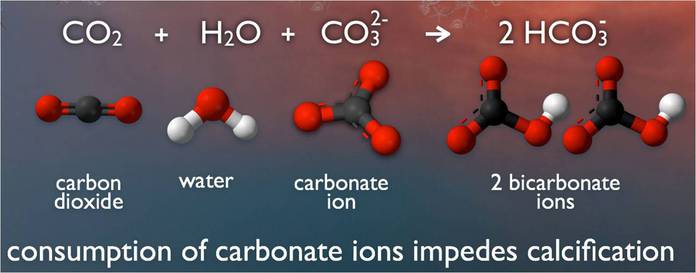
The rise in carbon dioxide emissions can be tied to a trend in ocean acidification. The Center for Environmental Visualization website states that the absorption of carbon dioxide by oceans causes the pH of the seawater to reduce, the concentration of the carbonate ion to decrease, and calcium carbonate minerals that become shells and skeletons of marine life to become less saturated (10). These effects are caused by chemical reactions that combine to be ocean acidification. Since the Industrial Revolution, the surface of oceans have become 30% more acidic, and it’s predicted that the oceans could become 150% more acidic. Carbon dioxide emissions would be to blame for this. Levels of pH have not been so low for 20 million years. The chemical equation for the reaction that uses up carbonate ions that are part of calcium carbonate minerals used by organisms to make skeletons and shells is shown in the picture below.
“Radiative forcing is the change that is caused in the global energy balance of earth relative to preindustrial times.” This quote was found from Scientific American (7). A positive radiative forcing induces warming and a negative forcing induces cooling. Radiative forcing of gases is determined by the atmospheric concentrations and the spatial distributions of specific substances.
The rise in carbon dioxide emissions can be tied to a trend in ocean acidification. The Center for Environmental Visualization website states that the absorption of carbon dioxide by oceans causes the pH of the seawater to reduce, the concentration of the carbonate ion to decrease, and calcium carbonate minerals that become shells and skeletons of marine life to become less saturated (10). These effects are caused by chemical reactions that combine to be ocean acidification. Since the Industrial Revolution, the surface of oceans have become 30% more acidic, and it’s predicted that the oceans could become 150% more acidic. Carbon dioxide emissions would be to blame for this. Levels of pH have not been so low for 20 million years. The chemical equation for the reaction that uses up carbonate ions that are part of calcium carbonate minerals used by organisms to make skeletons and shells is shown in the picture below.

Glacial retreat is the shrinking of glaciers, according to eduweb.com (11). An advance is when glaciers grow in size. Glaciers advance when precipitation causes them to grow more than melting and sublimation causes them to shrink. They retreat when the opposite occurs. Most glaciers today are retreating at higher rates than ever recorded.

Here’s a picture to back this up.

This relates to the rising sea level. It has been rising by about 1.77 millimeters per year over the last century. The number is much higher than that of the average rise in sea level over the past thousand years, according to the NOAA (6).
Sea levels rose by 17 cm globally in the past 100 years, according to NASA, but the rate that sea levels have been rising in the past ten years is about twice as fast as the past century (9). Since 1950, the number of record low temperature events have been declining as record high temperature events have been increasing in the United States.
Different companies in the United States have released statements (9) based on what they think is going on with climate change. The American Association for the Advancement of Science says that, “The scientific evidence is clear: global climate change caused by human activities is occurring now, and it is a growing threat to society.” The American Chemical Society claims that, “Comprehensive scientific assessments of our current and potential future climates clearly indicate that climate change is real, largely attributable to emissions from human activities, and potentially a very serious problem.” The American Geophysical Union states that, “Human-induced climate change requires urgent action.”
Global warming now stands out in history because the majority of it is believed by scientists to be caused by humans. It is occurring more significantly than it has for 1,300 years, by NASA’s count (10). Many of us in this century are on the same page. We hope the rest of the country and world will step on board to keep humanity safe long enough for you to read this letter.
Sincerely,
Avani Reddy and Liddy Malone
Footnotes:
1. Climate Change Indicators in the United States: The mission of the EPA “is to protect human health and the environment.” This website has many environment related articles. We specifically used the article titled, “Climate Change Indicators in the United States.”
2. The British Geological Survey is a world-leading geological survey. It focuses on public-good science for government, and research to understand earth and environmental processes. We used the article “Introduction to carbon capture and storage (CCS)”. http://www.bgs.ac.uk/discoveringGeology/climateChange/CCS/home.html
3. NASA stands for National Aeronautics and Space Administration. NASA is a United States government agency that is responsible for science and technology related to air and space. We used the article “Scientific consensus: Earth's climate is warming” from NASA’s Global Climate Change web page. http://climate.nasa.gov/scientific-consensus/
4. Climate and Weather: This website contains a collection of articles over topics such as, tornados, acid rain, lightning, hurricanes, and so forth. For our research, we used the articles titled, “What is Weather?” and “What is Climate?”
5. Nature.com: The mission statement of Nature.com is to “First, to serve scientists through prompt publication of significant advances in any branch of science, and to provide a forum for the reporting and discussion of news and issues concerning science. Second, to ensure that the results of science are rapidly disseminated to the public throughout the world, in a fashion that conveys their significance for knowledge, culture and daily life.” We used an article named “Climate Change: The Case of the Missing Heat.” This article helped explain some of the climate patterns in the world.
6. NOAA Global Climate Change Indicators: “NCEI is responsible for hosting and providing access to one of the most significant archives on Earth, with comprehensive oceanic, atmospheric, and geophysical data. From the depths of the ocean to the surface of the sun and from million-year-old sediment records to near real-time satellite images, NCEI is the Nation’s leading authority for environmental information.” On this website, we used many of the articles under the Global Climate Change Indicators tab.
7. Scientific American: “Scientific American, the longest continuously published magazine in the U.S., has been bringing its readers unique insights about developments in science and technology for more than 170 years.” On this website, we used an article titled “The Physical Science Behind Climate Change.”
8. The Committee on Climate Change (the CCC) is an independent, statutory body established under the Climate Change Act 2008. Our purpose is to advise the UK Government and Devolved Administrations on emissions targets and report to Parliament on progress made in reducing greenhouse gas emissions and preparing for climate change. We used the article “The science of climate change”. https://www.theccc.org.uk/tackling-climate-change/the-science-of-climate-change/
9. NASA stands for National Aeronautics and Space Administration. NASA is a United States government agency that is responsible for science and technology related to air and space. This information is from NASA’s Global Climate Change web page from the article “Climate change: How do we know?”. http://climate.nasa.gov/evidence/
10. The NOAA’s PMEL website had the useful article “What is Ocean Acidification?”. The mission of the NOAA is to advance our scientific understanding of the ocean carbon cycle and how it is changing over time in support of NOAA's commitment to improve the Nation's ability to anticipate and respond to climate impacts and to conserve and manage healthy oceans, coastal ecosystems, and marine resources.
11. Glacial Advance and Retreat: “Eduweb develops award-winning digital learning games and interactives about art, history, science and technology. Working with museums and educational organizations around the country, we produce digital games and apps for the Web, exhibits, and mobile devices.” On this website we used the information found in the article titled, “Glacial Advance and Retreat.”
Thursday, April 28, 2016
Starting Climate Science Research
To start off my research, I was most interested in the question: How has the climate of the earth changed over time? Wanting to start off broad, I basically pasted this question into the Google search bar. I was somewhat surprised to find an excellent source as one of the first results. NASA's website had an article on climate change that immediately gave me an impressive visual of the carbon dioxide levels over approximately the last 400,000 years. This was precisely the kind of information I wanted.

Below, in the same article, I found some more information. Throughout time, Earth’s climate has always changed. Often, these changes have been because of slight variations in the path of the planet’s orbit, since changes in the rotation of the Earth around the sun affects how much energy it receives. In the past 650,000 years, there have been seven cycles of glaciers on Earth advancing and retreating.
I was not familiar with this terminology concerning glaciers, so I found another website, eduweb, that explained these terms clearly. A glacier retreat is the shrinking of glaciers, and an advance is when glaciers grow. Glaciers advance when precipitation causes them to grow more than melting and sublimation make them shrink. They retreat when the opposite occurs. According to the website, most glaciers today are retreating at higher rates than ever recorded.
After all this, I clicked on another article about global warming that seemed promising. I found the link at the bottom of the NASA article. Apparently, glacier retreat has increased significantly in the past ten years. This can be related to the rise in sea level that has been rising by about 1.77 millimeters per year over the last century. This number is much higher than that of the average rise in sea level over the past thousand years. The website also had two interesting charts to back up these facts.


I found information about past and present trends in carbon dioxide levels, glacier retreat, and sea level in this research session. I want to do the same with other facets of climate next time.

Below, in the same article, I found some more information. Throughout time, Earth’s climate has always changed. Often, these changes have been because of slight variations in the path of the planet’s orbit, since changes in the rotation of the Earth around the sun affects how much energy it receives. In the past 650,000 years, there have been seven cycles of glaciers on Earth advancing and retreating.
I was not familiar with this terminology concerning glaciers, so I found another website, eduweb, that explained these terms clearly. A glacier retreat is the shrinking of glaciers, and an advance is when glaciers grow. Glaciers advance when precipitation causes them to grow more than melting and sublimation make them shrink. They retreat when the opposite occurs. According to the website, most glaciers today are retreating at higher rates than ever recorded.
After all this, I clicked on another article about global warming that seemed promising. I found the link at the bottom of the NASA article. Apparently, glacier retreat has increased significantly in the past ten years. This can be related to the rise in sea level that has been rising by about 1.77 millimeters per year over the last century. This number is much higher than that of the average rise in sea level over the past thousand years. The website also had two interesting charts to back up these facts.


I found information about past and present trends in carbon dioxide levels, glacier retreat, and sea level in this research session. I want to do the same with other facets of climate next time.
Tuesday, April 26, 2016
My Area of Interest From the List of Questions About Climate
Though several questions from this list piqued my interest, I would like to focus on one in particular: How has the climate of the earth changed over time? This is from the category called "climate science".
This area of research has the potential to be fascinating, because I could learn about the grand scheme of earth's weather and climate patterns and compare them to today. The research could go in several different directions, as well. I think the science aspect of this is interesting. A search could shed some light on the other questions (like "Is it real?") by establishing some basic facts about the history of climate. I could learn (or at least guess) what might come next. This would all tie in, possibly, to some of the political perspectives on the matter.
The topic makes me wonder: how far back can scientists be certain of the climate? How do they know this? How different is it today? Why are there discrepancies concerning what people believe about climate change when we live in such a scientific, fact based society?
This area of research has the potential to be fascinating, because I could learn about the grand scheme of earth's weather and climate patterns and compare them to today. The research could go in several different directions, as well. I think the science aspect of this is interesting. A search could shed some light on the other questions (like "Is it real?") by establishing some basic facts about the history of climate. I could learn (or at least guess) what might come next. This would all tie in, possibly, to some of the political perspectives on the matter.
The topic makes me wonder: how far back can scientists be certain of the climate? How do they know this? How different is it today? Why are there discrepancies concerning what people believe about climate change when we live in such a scientific, fact based society?
Monday, April 25, 2016
Climate
The first five words I think of when I hear "climate" are:
Change
Control
Heat
Hillary Clinton
Money
I think about the polarization of today's political parties concerning climate change; that is why I said Hillary Clinton, I guess. About 150 countries just signed that big agreement, though, so I suppose that means the political environment is not too incredibly divided. I think about global warming and the science and funds needed to prevent it from continuing.
A question: How significant of an international effort is needed to revert the trend of climate change?
Change
Control
Heat
Hillary Clinton
Money
I think about the polarization of today's political parties concerning climate change; that is why I said Hillary Clinton, I guess. About 150 countries just signed that big agreement, though, so I suppose that means the political environment is not too incredibly divided. I think about global warming and the science and funds needed to prevent it from continuing.
A question: How significant of an international effort is needed to revert the trend of climate change?
Wednesday, April 13, 2016
Questions About the 1930s
For homework, I was first asked to read about the Great Depression.
According to this article, what was wrong with President Hoover's response? Why did people blame themselves when things went wrong, and how valid or invalid was this response?
President Hoover responded to the economic crisis by not properly recognizing it as a lasting threat. He proposed trickle-down economics instead of giving relief to those in need.
Since it was the mindset of the time period that success came with hard work and was due to one's actions, people, especially men, blamed themselves when they struggled. This was an invalid response, because one-fourth of the workforce was laid off. It was not their fault.
President Hoover responded to the economic crisis by not properly recognizing it as a lasting threat. He proposed trickle-down economics instead of giving relief to those in need.
Since it was the mindset of the time period that success came with hard work and was due to one's actions, people, especially men, blamed themselves when they struggled. This was an invalid response, because one-fourth of the workforce was laid off. It was not their fault.
I then read about Black Sunday.
How would you have felt if you'd been there on that day? What kinds of fears, concerns, or questions would be going through your mind during, and after, the event described?
That day sounded terrifying. I would have panicked if I was hit by a dust storm and could not see anything. Before being hit, my only thoughts would be escaping the cloud and frantically finding safety. During, I would probably not be able to think of much else besides my own safety and my family's. I would be concerned about how hard my friends, family, and possessions were hit after the storm passed.
That day sounded terrifying. I would have panicked if I was hit by a dust storm and could not see anything. Before being hit, my only thoughts would be escaping the cloud and frantically finding safety. During, I would probably not be able to think of much else besides my own safety and my family's. I would be concerned about how hard my friends, family, and possessions were hit after the storm passed.
Next, I clicked on a link about The Drought.
What areas were affected by it? What caused it? The author ends this article with a pithy quote. Do you agree or disagree with this historian's perspective? Why or why not?
About a third of the Great Plains, including most of the Texas panhandle, northeastern New Mexico, Western Kansas, Southern Colorado, and the Oklahoma panhandle, were included in the Dust Bowl, the area largely affected. The drought was worsened because settlers misused the land with their farming techniques. They planted too much wheat, which was unhealthy for the soil. Cattle and sheep were let to overgraze, so wind erosion became an all too legitimate problem.
The author concludes the passage with this quote: “The ultimate meaning of the dust storms of the 1930s was that America as a whole, not just the plains, was badly out of balance with its natural environment. Unbounded optimism about the future, careless disregard of nature’s limits and uncertainties, uncritical faith in Providence, devotion to self-aggrandizement – all these were national as well as regional characteristics.” Though I am not an expert on the matter, I would agree. The quote reminds me about how the passage about the Great Depression described the cause of the stock market crash. After consumerism rose in popularity, Americans seemed to excitedly spend more money than they really had. Their optimism about the future put them out of touch with both reality and their own weaknesses. The author felt the settlers in the Dust Bowl were the same.
Finally, I read about Mass Exodus from the Plains.
Were does the migration of people out of the Dust Bowl rank in terms of other migrations in US History? What made life hard for people once they arrived in California?
The migration of people out of the Dust Bowl was the largest in America's history. Life was hard once these people arrived in California. The farms there were larger, different, and owned by companies. So many people were in need of jobs that the people that worked were paid very little. Additionally, the cost of living was exorbitant. Many lived in squalor, and diseases broke out as a result. Finally, California natives were sometimes unwelcoming and could be discriminatory toward the migrants.
The migration of people out of the Dust Bowl was the largest in America's history. Life was hard once these people arrived in California. The farms there were larger, different, and owned by companies. So many people were in need of jobs that the people that worked were paid very little. Additionally, the cost of living was exorbitant. Many lived in squalor, and diseases broke out as a result. Finally, California natives were sometimes unwelcoming and could be discriminatory toward the migrants.
1930s Word Cloud
When we see “the 1930s”, what do we think? (Madi, Karen, Mary Leigh, Skyler, Valeria)
RADIO
"FIRESIDE-CHATS"
THE-NEW-DEAL
FDR
ECONOMY-CRASH
THE-LONE-RANGER
RADIO-SHOWS
STOCK-MARKET-CRASH
GREAT-DEPRESSION
BREAD-LINES
BANK-CLOSINGS
TVA
POVERTY
HOOVERVILLES
ADULT-GEORGE-BAILEY
RADIO
FDR
AMELIA-EARHART
MEN-IN-SUITS-AND-HATS-AND-FUNNY-ACCENTS
GREAT-DEPRESSION
RADIO
POOR
STRUGGLE
RADIO
GREAT-DEPRESSION
MY-GRANDMOTHER
SOUP-KITCHENS
FDR
MORE-JOBS
DIRT-POOR
STOCK-MARKET- CRASH
RADIO
FIRE-SIDE-CHATS
POLITICS
ADVERTISING
GREAT-DEPRESSION
STOCK-MARKET-CRASH
BLACK-AND-WHITE-TV
GREAT-DEPRESSION
POVERTY
UNEMPLOYMENT
STOCK-MARKET
BANK
FDR
CCC
TVA
NEW-DEAL
FIRESIDE-CHATS
BONUSES
HOOVER
HOOVER-DAM
RADIO
HOOVERVILLES
FOUR-TERMS
Subscribe to:
Posts (Atom)